A friend sent me this short and interesting essay on ‘fake’ traditions by Angela Puca. I don’t know Dr Puca’s work – I’m not a video person – but I’m cheered that public-facing scholarship on esoteric and occult can be this sincere, intelligent and insightful. I agree entirely with its general stance, and it is especially true that inflated expectations can, ironically, cause people to miss real popular folk magic, heterodoxies and syncretisms.
It’s hard to convey, at this distance, just how furious responses to Hutton’s Triumph of the Moon were, despite its main contention being well known among reasonably educated occultists. Anger is an understandable response to the pain of losing something precious. Disillusionment, disquiet, or despair are more common responses, if less public. Predictably it produced a fertile market for witchy hucksterism: well, Gardner’s tradition is all bodged-up bits of Crowley and folklore, but let me tell you about my real witch cult…
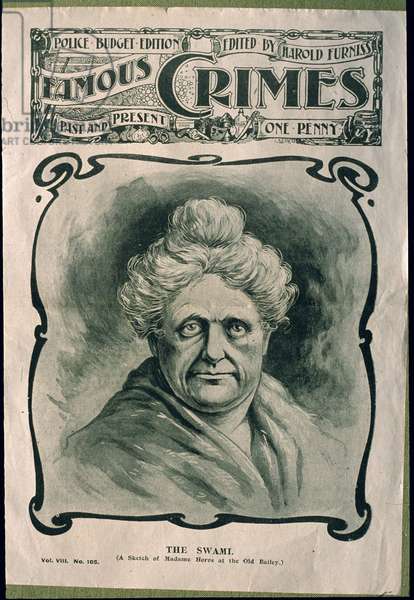
British occultism has been here before, of course: the humiliating Horos affair led to the implosion of the original Golden Dawn, including a slanging match about its dubious origins and ginned-up cipher manuscripts. Thelemites sometimes undergo an internal crisis when they come face-to-face with just how revolting, devious and – ultimately – sadly dissipated old Uncle Al really was. Implausible ‘family’ witch lineages (passed on by the conveniently dead) were ten-a-penny in the 20th century. Perhaps more surprising than those disillusioned at the tawdry end of the old GD were the surprising number of Adepti determined to continue, under new names or taking its light to new hearths.
When I was younger and brasher I used to enjoy arguing with pagans who peddled historical claptrap. If you had asked me at the time, I would have said it was insulting to the gods and to sincere seekers to lie in that way, or that effective magic depends on discernment (among other things to avoid embarrassing Inflated Magus Syndrome). Dubious history can get in the way of really deepening our practice and our thinking. I still think that’s true. But like many bright young men, I also enjoyed showing off, and being the smartest in the room. I was certainly sometimes needlessly abrasive. Twenty years of meditating on your heart centre will change you.
But those weren’t my only motives, although I didn’t know that at the time. Behind my conscious frustrations was a more intractable anxiety. At its simplest: what if I was being a fool? Certainly these practices induced powerful spiritual experiences in me, and had already begun to change my life, but I worried about the tacit hostility to critical inquiry in ‘pagan’ or occult spaces. Worse, what if I laid myself open to something, vulnerable, and it turned out to be a lie? Wouldn’t that make me a dupe? My only way of squaring it at the time was to marry an intense magical practice to an equally intense critical, intellectual one outside of the circle. Nothing would get past me, so I could never be vulnerable to the pain of disillusionment or loss. Ultimately, however, that armour could not endure. Magic will lay you open.
I have much more nuanced feelings about ‘sacred history’ today, not least that it sometimes acts as a necessary initial scaffold for forming a practice (though it can also deform it). I have come to know that the published history of magical groups in the 20th century is a true patchwork: not everything always comes to light. As I have written about elsewhere, our own tradition tends to underplay how much magical ‘technology’ it adapted from the common language of post-war British ritual magic (visualisation, vibration and so on). But there is also no doubt in my mind that it is a distinctive articulation of the wider Hermetic current, quite separate from the Rosicrucian mysteries and with a much stronger connection to the Hermetica proper – and their long reception in western estoericism.
Here I find it helpful to step out of the sometimes parochial intellectual bounds of occulture. Early twentieth century theologians wrestling with secular modernity spoke of a ‘second naiveté’ – zweites Naivität – arrived at on the far shore of historical-critical scepticism. The term is often associated with Paul Ricoeur, and counterposed to the culture of suspicion he identified as constituting modernity. It’s easy to see why philological and historical-critical approaches might engender crises in scripture-oriented faiths, but the corrosive effects of a hypervigilant suspicion are familiar well beyond them. Most interestingly, these writers prize the ‘second naiveté’ not because it is a regression to a pre-sceptical state, but rather a restored faith which can contain the fruits of doubt in a new form – free from ecclesiastical tyranny, shrill fundamentalism, adequate to the modern world and its difficulties. Often they emphasise that it is a dynamic state, which has to be renewed in constant intellectual, moral and prayerful dialogue.
Charles Stang, who heads the Center for the Study of World Religions at Harvard, has suggested the secret engine of religious scholarship is often seekership. One reading of this insight is that an anthropological or historical framework is a way of approaching intense spiritual material without being inside it – with no risk of burnt fingers. Sometimes, of course, that means yearning for it, and never quite being able to live the thing one yearns for. And, like all secret motives, it can also be repressed, disclaimed, turn sour, envious, or desiccated. Some of these risks – living primarily in the intellect, observing rather than being – are risks for educated practitioners too.
Western esotericism in fact has much to offer here. Firstly, in its reading of texts. Sallustius, when propounding his non-literalist, esoteric understanding of pagan myths, tells us that ‘these things never happened but always are’ (ταῦτα δὲ ἐγένετο µὲν οὐδέποτε, ἔστι δὲ ἀεί, §IV ed. Nock). He goes on to say that mind (νοῦς) grasps their inner truth all at once, even though they are presented as narratively sequential. Similarly, a modern magician might understand his tradition as an ongoing revelation of divinity through history, and through the creative work of the individual magician as both receiver and transmitter of that tradition. (One might well understand the ongoing Christian and Hermetic reception – and modification – of Qabalah in this light.)
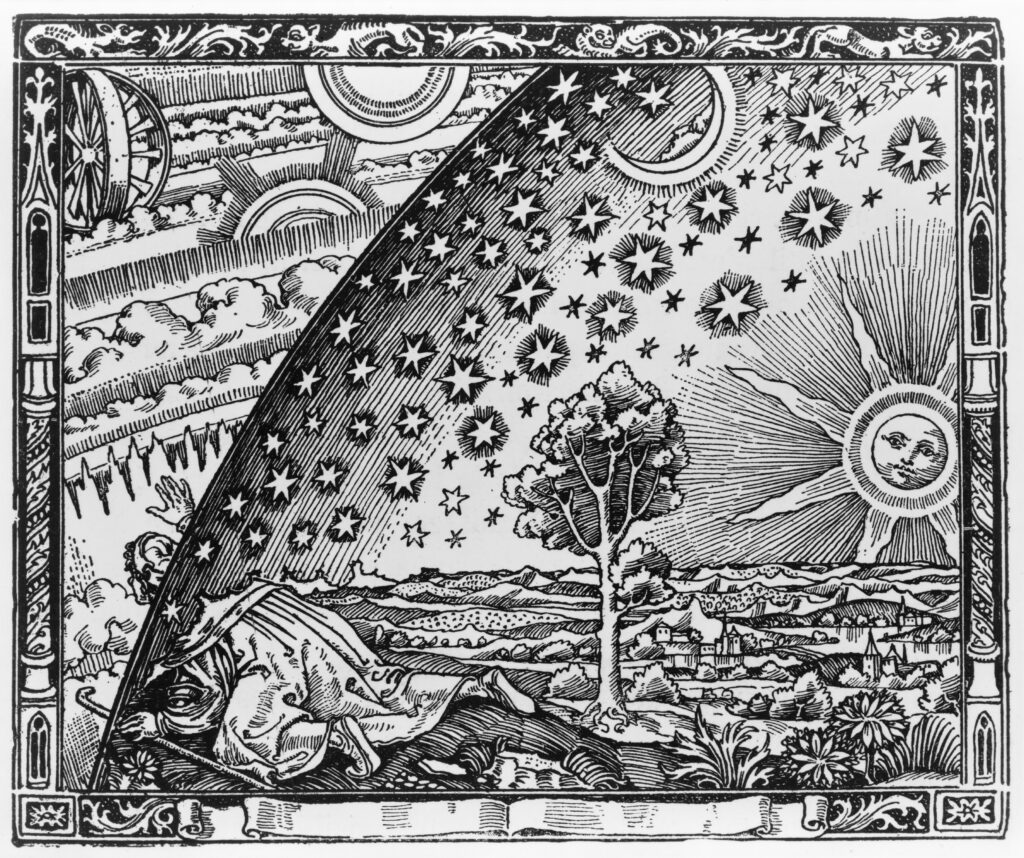
But there is a strong division between scripture-oriented theologians and the theurgist or esotericist. We undertake practices that bring us in to direct, subjective contact with spiritual realities. We do so to such an extent that it profoundly alters our understanding of the kosmos, and brings us into contact with other intelligences and powers. We perceive things, and bring things about, in ways which seem impossible to ordinary consciousness. Whatever the Goddess told Frater Perdurabo, these experiences alone do not bring ‘certainty, not faith’ in themselves: understanding and unpacking them requires intellectual grounding and a capacity for integration. These do not necessarily arise from the experiences themselves. But they are a powerful basis for that reintegration on the other side of all-corrosive scepticism.
To be clear, this is not a defence of fake history or its pedlars. Spiritual teachers have a responsibility to their students to offer them truth in its fullest sense, including the historical. Dodgy history, even now, is used to manipulate the innocent. But it is an argument that ‘sacred histories’ evoked in ritual contexts can express a spiritual truth quite distinct from their grounding in fact. It is so with the scriptural genealogy of Christ, and it is so with the sabbat of the Witches.
Let me speak finally as a practitioner, then. I am an inheritor of a spiritual tradition which is both young and immeasurably old. Every morning I invoke the spiritual powers of that line, and place myself in their lineage. If I speak of ‘faith’, I mean ultimately faith in that current. At the same time, only sporadically does that line appear in history, a history also mediated by books and texts, some of which seem to disappear only to be rediscovered centuries later, or which survive the fall of empires near miraculously. (The initiate’s discovery of a hidden text is a motif of Hermetic literature across many centuries, strikingly similar to the Tertön in Tibetan Buddhism.) Our twentieth and twenty-first century history has its share of splits and filiations. This does not trouble me: I see the providential work of spiritual powers in it. What is most striking above all is how the current finds a means to express itself, like an underground fount of living water suddenly bursting, unsuspected, from a rock. As a Hermeticist whose work centres around spiritual regeneration (palingenesis) it is both pleasing and spiritually right to perceive that the Hermetic current is a self-regenerating one.
Interesting as always.
I was hoping for a gleeful dissection of the Aurum Solis own history…
I’ve always suspected that tracing the lineage of the order in line with the Order of the Helmet, a mock organisation, was a an erudite joke for the eyes of the discerning practitioner who could see through the artificial nature of the historical narrative provided.
No hard feelings about that, at a stretch, Noble Lie, in the Platonic sense,